Innovating Digital Lending Through Creative Coding

Imagine a world where designers and developers must meet the rising demand for hyper-personalized lending solutions. The challenge? Creating applications that are not only functional but also engaging and efficient. Enter creative coding—a technique that bridges the gap between design and programming, enabling financial technology companies to craft tailor-made digital experiences that cater to both borrowers and financial professionals alike. By adopting a design-first approach, both designers and developers can collaborate to produce high-end, customized applications that stand out in a crowded market.



 

  •  Creative Coding Benefits:   Creative coding blends art with programming to create unique, engaging customer experiences that   differentiate  products in a competitive market. This impact is seen in several ways:
  • Customizing Visualizations: Developers leverage coding to create unique, memorable data representations Financial institutions use real-time interactive visualizations, like heat maps and trend lines, for better decision-making.
  • Enhancing User Experience: Creative coding integrates intuitive elements like hover states, tooltips, and gamified interactions, simplifying loan applications with accessible, engaging UIs.
  • Storytelling with Data: By using animation, transitions, and sound, developers turn raw data into compelling narratives.
  • Building Emotional Connection: Thoughtful user flows evoke emotional responses, making applications more relatable and memorable.
  • Simplifying Complexity: Complex data and abstract concepts are broken down into clear, digestible visualizations.
  • Fostering Innovation: A design-first approach drives innovative UI designs, pushing boundaries and improving
    customer experiences.

Process and Team Involvement: 
The process of creative coding begins with collaboration between designers, developers, and product managers, where ideas are brainstormed and rapidly prototyped. An iterative development approach is essential, with continuous feedback and adjustments ensuring that the final product is both functional and engaging. Rigorous testing and optimization guarantee a seamless user experience, while staying up to date with the latest tools and trends helps teams push the boundaries of innovation.

Frontend Development: 

  •  React.js: Popular for interactive UIs
  • D3.js: Custom data visualizations
  • Processing: Artistic, abstract visualizations
  • Angular: Bidirectional data binding and comprehensive tools for sophisticated UIs
  • Three.js: 3D graphics framework
  •  

Backend Processing: 

  • Python with Matplotlib: Data processing and analysis
  • GraphQL: API back-end technology

Visualization: 

  • Tableau: Versatile tool with custom scripting

Animation Tools: 

  • Framer Motion: Complex animations for React with simple syntax
  • Lottie: Interactive animations from After Effects
  • GSAP: High-performance HTML5 animations for responsive user interactions
  • Figma: Hi-fidelity UI design and prototyping, with dev handover features
  • After Effects: Complex animations embedded into web applications

Additional Tools and Technologies: 

  • Flexbox and Grid: Responsive CSS layout modules
  • Web Frameworks: For web-based visualizations (React, Vue.js, Angular)
  • Data Preparation Tools: For data preprocessing (Pandas, NumPy)
  • Version Control: Project code management (Git)
  • Generative Design: Automating processes, personalizing offers, enhancing risk assessment

Generative Design Software Requirements: 

  • Deep Learning Frameworks: TensorFlow, PyTorch, Keras
  • NLP Libraries: NLTK, spaCy, Transformers for text processing
  • Data Visualization Libraries: D3.js, Plotly, Matplotlib, Bokeh

Strategic Value:

Interactive data visualization and Intuitive UI empowers financial institutions to:

  • Monitoring Performance: Track key metrics and trends
  • Uncover Patterns: Identify correlations and outliers missed in static reports. For instance, visualizing borrower demographics against default rates helps banks adjust lending strategies to mitigate risk
  • Conversion  Rates: Increases applicant engagement and motivation
  • Differentiation: Provides a competitive edge through superior customer experiences

Creative coding is transforming lending applications by merging design with technology, creating personalized, engaging user experiences. In the future, we can expect deeper customization, real-time insights, and AI-driven features that enhance decision-making and customer satisfaction. As the field evolves, creative coding will continue to drive innovation, setting new standards in digital lending and providing a strong competitive edge.

Nimble MSME Loan Solution – A Winning Formula for MSME Lending

The Indian MSME sector, the lifeblood of our economy faces a familiar challenge: access to credit. Traditional methods rely heavily on credit history, a hurdle for young businesses. Here’s where Craft Silicon’s Nimble Business Loan Origination System steps in, offering a powerful solution with industry-specific cash flow analysis to revolutionize MSME lending in India.Imagine Ravi, a chaiwallah at the end of the street busily brewing tea/coffee in his shop. He looks to get a business loan to expand his tea shop into a coffee café. While Ravi lacks a long credit history, his consistent customer flow and daily sales paint a clear picture of his cash flow potential. Nimble empowers lenders to go beyond basic credit history. They can configure a custom cash flow analysis template specifically designed for chaiwalas. This template might include questions like:


  • Daily Sales:How many cups of tea, coffee, Horlicks do you sell in the morning, afternoon, and evening?
  • Pricing: What’s the cost per cup?
  • Operational:How many days per month do you operate?

Nimble then gathers Ravi’s responses and combines them with industry benchmarks to generate a customized cash flow forecast. This forecast considers seasonal fluctuations and peak hours, providing a clearer picture of Ravi’s earning potential.

Nimble: Unlocking the Potential of Every MSME with Unmatched Flexibility 

Nimble empowers lenders (banks and NBFCs) with the tools they need to thrive in the new era of MSME lending

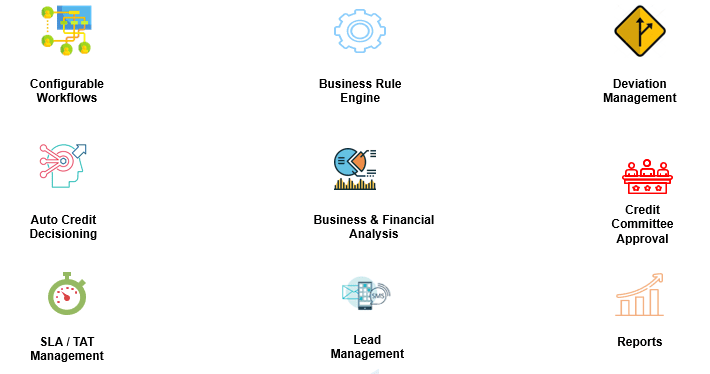
  • Configurable Cash Flow Analysis:Nimble allows lenders to design industry-specific cash flow analysis templates. These templates capture the unique income and expense structures of different MSME sectors (e.g., chaiwalas vs. tailors vs grocery shop owner).
  • Data-Driven Decisions:Nimble goes beyond cash flow analysis. It integrates with credit bureaus and allows lenders to configure risk-based pricing models based on factors like CB score, average monthly balance, and repayment history.
  • Internal Credit Scoring:Nimble empowers lenders to develop their own internal credit scoring systems for MSMEs. These systems consider multiple parameters relevant to an MSME’s industry, like Ravi’s daily sales volume or a tailor’s average order value.
  • Multi-Level Loan Approval:Nimble supports a customizable loan approval matrix based on both internal credit score and loan amount. This allows lenders to streamline approvals while maintaining appropriate risk management.

Enhanced Configurability and Risk Management: 

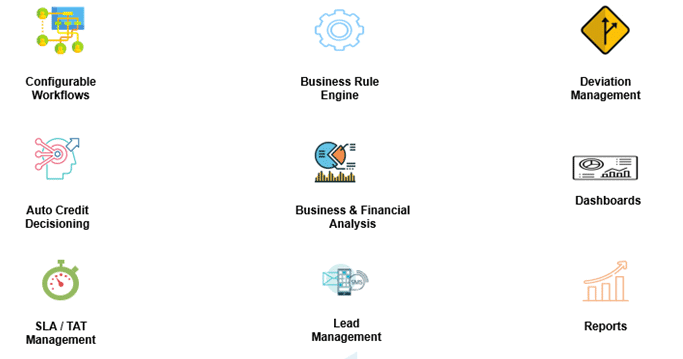
  • In-House Dynamic Business Rule Engine (BRE):Nimble offers a powerful BRE system. Lenders can configure rules for various aspects like KYC verification, loan origination, loan servicing, credit bureau checks, and more. This ensures compliance and streamlines processes.
  • In-House Dynamic Business Rule Engine (BRE):Nimble allows for multi-level approvals when system deviations or manual overrides occur. Deviation-wise approval roles (business, risk, credit, etc.) can be configured for granular control.

Seamless KYC and Financial

ssessment: Nimble seamlessly integrates with the MSME Udyam registration system, allowing lenders to fetch Udyam certificates for faster loan processing.

  • Bank Statement Analysis: Nimble analyzes the borrower’s past 6 months of bank statements, providing a consolidated view of their cash flow. This complements the customized cash flow analysis for a holistic financial picture.
  • KYC Authentication: Nimble supports Aadhaar offline KYC, PAN verification, and voter ID authentication for secure and efficient KYC checks.
  • MSME Udyam Integration: Nimble seamlessly integrates with the MSME Udyam registration system, allowing lenders to fetch Udyam certificates for faster loan processing.

Benefits for Lenders:

  • Expanded Reach: Confidently tap into the vast potential of the MSME sector with tailored cash flow analysis for each industry.
  • Reduced Risk: Data-driven decisions based on comprehensive financial health assessments lead to better loan performance and reduced risk exposure.
  • Competitive Advantage: Offer innovative loan products with risk-based pricing and cater to the specific needs of diverse MSMEs.
  • Increased Efficiency: Streamlined processes, automation, and a powerful BRE significantly improve operational efficiency for lenders.
  • Enhanced Risk Management: Granular control over approvals and dynamic rule configuration ensure compliance and mitigate risk.

Ready to unlock the power of Nimble for your MSME lending? Contact Craft Silicon today!

The Impact of Customer App (Lending) on Financial Institutions

The significance of Customer App in the lending sector was highlighted during the COVID-19 lockdown in 2019, prompting financial institutions worldwide to embrace digitalization to remain competitive. The challenges posed by the pandemic made it increasingly difficult to cater to customer needs in person, underscoring the importance of digital solutions to stay ahead in the market.

Accelerating Digital Transformation
As lockdowns and restrictions made in-person interactions challenging, financial institutions worldwide were compelled to accelerate their digital transformation to remain competitive in the market. Organizations that had previously invested in digital infrastructure including customer lending apps found themselves better equipped to navigate the challenges brought on by the pandemic.

Recognizing the need to adapt swiftly, many financial institutions partnered with technology firms to expedite digitalization efforts, particularly in lending processes. This led to a surge in innovative lending solutions designed to meet customers’ evolving needs.

Benefits Beyond Financial Institutions
However, the benefits of this digital shift extended beyond financial institutions alone. Customers also enjoyed significant advantages, as digital lending application technologies offered:

  • Convenience
  • Transparency
  • Enhanced accessibility to banking services for the end borrower.

Moreover, the broader societal impact was profound, with Customer Apps in lending contributing to the stability of the financial institutes’ business models by facilitating customer retention and promoting mediums of touchless transactions.

Supporting Small Businesses
Amidst the economic turmoil caused by the pandemic, small businesses bore the brunt of financial hardships. To alleviate their struggles, national banks, such as those in India, swiftly implemented touchless customer applications as one of the adoptions in the entire digital lending spectrum. These solutions streamlined the loan application process, providing small businesses with rapid access to much-needed funding.

Key Data Points 
Key data points from this period underscore the effectiveness of Customer App in benefiting financial institutions during the pandemic:

  1. Number of Loan Applications: National banks received a staggering 10,000 loan applications from pandemic-affected small businesses.
  2. Average Loan Processing Time: Leveraging digital lending platforms, banks reduced the average loan processing time to a mere 2 days, significantly faster than traditional methods.
  3. Loan Approval Rate: A remarkable 70% of loan applications were approved, providing vital financial support to 7,000 small businesses.
  4. Loan Amount Disbursed: A total of $100 million was disbursed to small businesses, enabling them to retain employees, cover operational expenses, and navigate the challenges posed by the pandemic.
  5. Economic Impact: The financial support extended by banks played a pivotal role in maintaining employment levels, ensuring business continuity, and stimulating economic activity nationwide.


Beyond Immediate Benefits

In addition to the direct benefits to financial institutions, digital lending solutions also facilitated:

  • Automated loan origination
  • Streamlined risk assessment processes
  • Enhanced cross-selling opportunities for personalized offerings.

This not only helped reduce operational costs but also promoted greater convenience, transparency, and accessibility for customers.

A Nation Embracing Digitalization
As our nation increasingly embraces digitalization, financial services are brought to the doorsteps of individuals, including our elder population. This accessibility ensures that all members of society can easily access banking services and products, further reinforcing the importance of digital transformation in the banking sector.

The Evolution of Co-lending

Co-lending has significantly evolved over the years, revolutionizing the way financial institutions collaborate to fund projects and businesses. Understanding the roots and importance of co-lending is crucial to understanding its current impact on the financial sector. Co-lending plays a fundamental role in promoting financial inclusion by providing access to capital for individuals and businesses that may not meet traditional lending criteria. It fosters innovation, enables priority sector like MSME, and facilitates economic growth.

What is Co-lending?

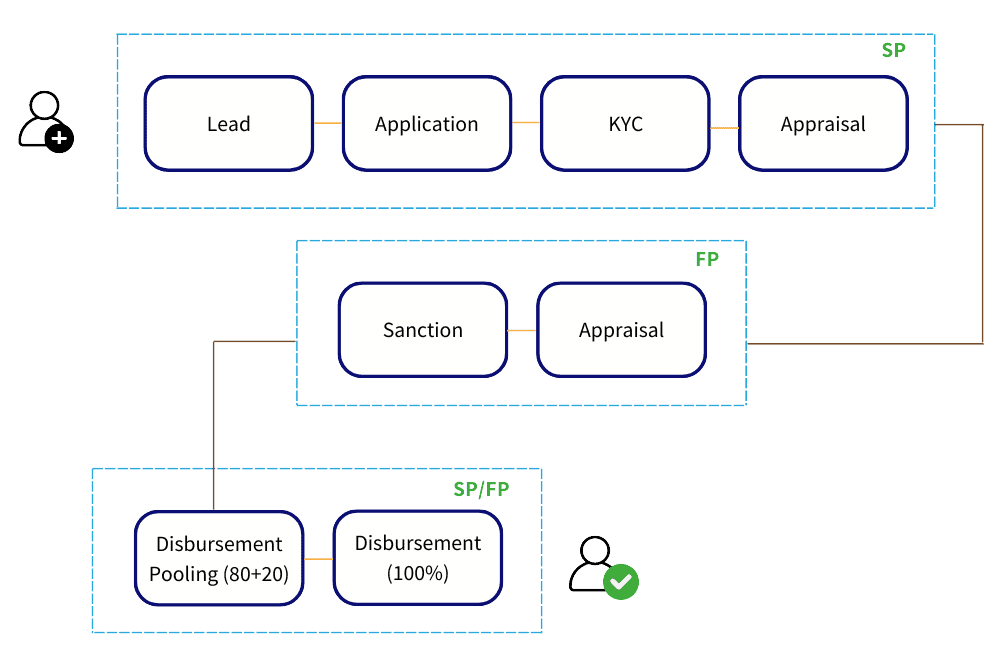
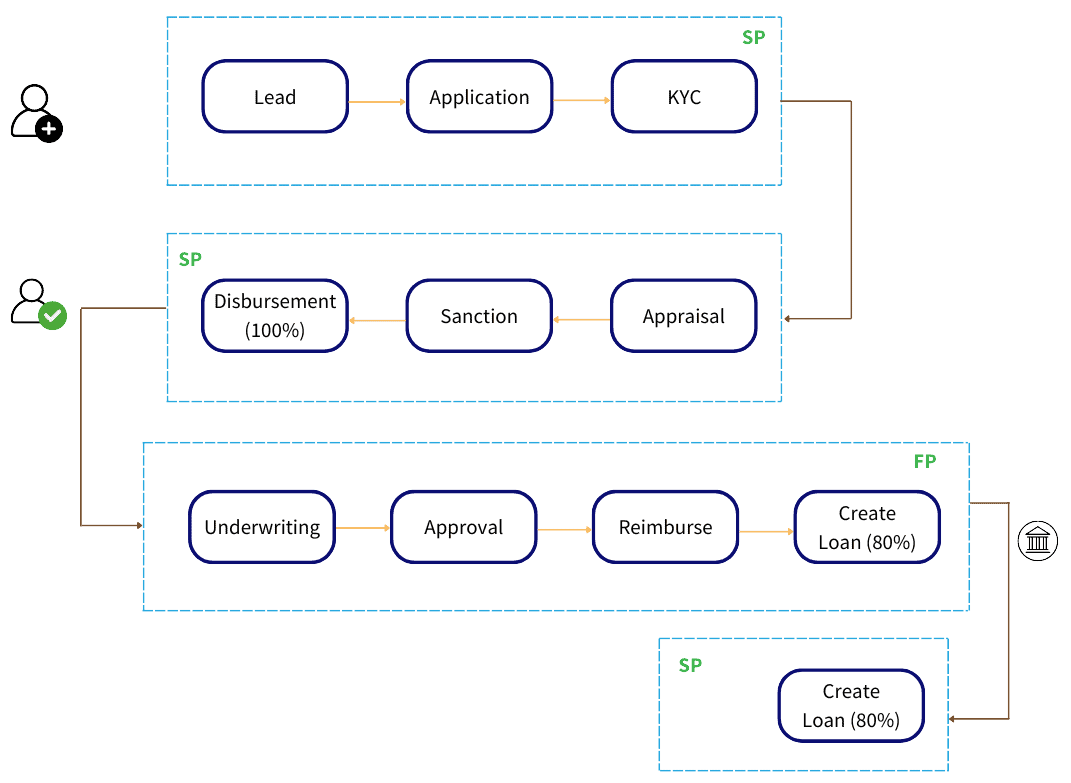
Co-lending involves collaboration between two types of partners: the Financing partner and the Servicing partner.

  • Financing Partner(FP): This partner contributes a larger percentage of the loan amount in the partnership. They provide the bulk of the capital needed for the loan.
  • Servicing Partner(SP): This partner is responsible for servicing loan to customer. Their roles include primary sourcing of the loan, managing loan repayments(collections), & acting as the main point of contact for the customer throughout the loan process.In this arrangement, the financing partner ensures the availability of funds, while the servicing partner handles the operational aspects of the loan, ensuring smooth management and repayment. This collaboration allows for the pooling of resources and expertise, leading to more efficient and inclusive lending practices.

History of Co-lending

The concept of co-lending dates back to ancient civilizations, where groups of individuals would pool resources to support fellow community members in need. Fast forward to modern times, banking institutions began formalizing co-lending practices to cater to diverse financial requirements.

Reserve Bank of India (RBI) Guidelines

The RBI has issued guidelines to formalize co-lending arrangements, particularly between banks and non-banking financial companies (NBFCs). The Co-Lending Model (CLM), introduced in 2020, aims to enhance credit flow to priority sectors by leveraging the comparative advantages of banks and NBFCs.

Types of Co-lending Models

  • CLM 1 – In this model, all the co-lenders jointly fund the loan amount according to pre-agreed ratios.

For example, Lender A funds 80% while Lender B funds 20% of the total loan amount.

  • CLM 2- Reimbursement-based Co-lending- Here, one lender disburses the full loan amount first. Subsequently, the other lender reimburses a percentage of the loan, say 80%, to the first lender as per the co-lending agreement. This model is similar to Direct Assignment.

Benefits of Co-Lending

Co-lending offers numerous advantages for lenders, borrowers, and the overall financial ecosystem.

  • Risk Diversification- By spreading loan exposure across lenders, co-lending significantly reduces the risk of any single lender facing substantial losses. This diversification strategy enhances financial stability and resilience.
  • Increased Loan Approvals- Co-lending increases the likelihood of loan approvals for borrowers, especially those with unique or complex financing needs. Two lenders bring diverse perspectives and expertise to evaluate loan applications, leading to more inclusive lending practices.
  • Lower Interest Rates for Borrowers- Collaborative lending often results in competitive interest rates for borrowers, as lenders work together to offer attractive terms and conditions. This fosters healthy competition in the lending market, benefiting borrowers with cost-effective financing options.

For Example:

Consider a co-lending partnership involving two lenders:

Lender A has an interest rate of 18% and contributes 80% to the loan amount. Lender B has an interest rate of 14% and contributes 20% to the loan amount. The blended rate of interest for the customer can be calculated using the following formula will be 17.20%

Formula : (Funder A Share % * Interest Rate of Funder A) + (Funder B Share % * Interest Rate of Funder B)

Using the given percentages and interest rates:

Blended Rate of Interest = (0.80×18%) + (0.20×14%)

Blended Rate of Interest = 14.4% + 2.8%

Blended  Rate of Interest  = 17.2%

Challenges of Co-lending

Despite its benefits, co-lending comes with its set of challenges that require careful consideration and strategic management.

  • Coordination and Communication Issues- Coordinating two lenders, aligning on terms, and maintaining effective communication throughout the lending process can be challenging. Ensuring transparency, clarity, and accountability among all parties is essential to overcoming these hurdles.
  • Credit Risk Management- Managing credit risk in co-lending arrangements demands robust credit assessment, monitoring mechanisms, and risk mitigation strategies. Lenders need to evaluate borrower creditworthiness, set appropriate risk limits, and monitor loan performance diligently to safeguard their financial interests.
  • Technology Integration- Advancements in financial technology (FinTech) are revolutionizing co-lending processes, enabling digital platforms for seamless loan origination, underwriting, and servicing.
Solution for the challenges

Our Nimble co-lending system provides an effective solution by handling communication and balance management between both partners. Nimble co-lending acts as an intermediary, facilitating smooth interactions and operations between the serving partner and the financing partner.

  • Enhanced Coordination and Communication: Nimble co-lending ensures effective communication channels between lenders, promoting transparency and clarity. The system provides a centralized platform for sharing information, aligning on terms, and tracking progress, thereby minimizing coordination issues.
  • Improved Credit Risk Management: By monitoring Nimble co-lending helps in conducting thorough credit assessments and setting appropriate risk limits. It continuously monitors loan performance, offering real-time insights to both partners, which aids in proactive risk mitigation.
  • Seamless Technology Integration: Nimble co-lending pulls progressive solutions to loan origination, underwriting, and servicing. This integration streamlines processes, reduces manual efforts, and enhances operational efficiency, making co-lending more effective and scalable.

Through these features, Nimble co-lending plays a pivotal role as a middle layer, ensuring smooth collaboration between the serving and financing partners, ultimately leading to a more efficient and effective co-lending process.

Summary

Co-lending provides risk diversification, increased loan approvals, and competitive interest rates while requiring effective coordination, regulatory compliance, and credit risk management.

  • Lenders can mitigate credit risk by conducting thorough credit assessments, setting risk limits, and implementing robust monitoring mechanisms.
  • Borrowers benefit from increased loan approvals, competitive interest rates, and access to diverse funding sources through co-lending.
  • Technology integration enables automation, data analytics, and digital platforms for seamless loan origination, underwriting, and servicing in co-lending.

Transforming the Way we Work- Scrum, Waterfall or just Go “Agile” – Part II

(contd. from part I…..)Transforming from Waterfall or hybrid to Agile is a significant shift in project management methodology, but it can be capitalized on with careful planning and execution. It can also bring significant benefits to an organization, such as increased flexibility, faster time-to-market, improved collaboration, and adaptability to changing requirements.

It’s important to note that this transformation requires a cultural shift, collaboration, adaptability as well as process change. It takes time and effort to overcome resistance and establish a new way of working, but the benefits of being Agile, such as faster time-to-market, better quality, and higher customer satisfaction, can be worth the investment. Therefore it’s important to communicate the benefits of agile to stakeholders and manage expectations regarding flexibility, continuous feedback, and the iterative nature of project delivery.

Proper assessment of the current state of the organization and identification of areas for improvement is important to ensure a smooth transition and implementation of the process into the company’s culture.

Here are some steps that we are using to transform from Hybrid to Agile:

  1. Assessing the current situation: Understand the reasons for the shift, evaluate the current processes, and identify the challenges and opportunities for improvement.
  2. Creating a plan: Develop a roadmap for the transformation, including the timeline, budget, resources, and key performance indicators.
  3. Involving your cross-functional team: Involve all stakeholders, including the development team, management, customers, and end-users, in the transformation process.
  4. Define what you need: Choose the most suitable framework and tailor it to the project’s requirements.
  5. Educate the team: Train the team on the Agile principles, practices, and tools, and ensure that everyone is aligned with the new way of working.
  6. Implement Agile practices or let’s just say best Practices: Introduce Development Best Practices such as user stories, backlog grooming, sprints, daily stand-up meetings, and retrospectives, to promote collaboration, transparency, and feedback.
  7. Adapt and improve: Continuously evaluate the process, measure the outcomes, and adapt the methodology to improve the project’s efficiency and quality.

Running Agile with Waterfall-

Agility is a characteristic of the Agile methodology, which is an iterative and incremental approach to software development. Waterfall, on the other hand, is a linear and sequential approach to project management. Agility in Waterfall can refer to the ability of a Waterfall team to adapt to changing circumstances or requirements during a project. While Waterfall is typically a more rigid methodology, there are certain practices that can increase agility in a Waterfall environment:

  1. Breaking down the project into smaller phases: This can enable more frequent checkpoints and feedback loops, allowing the team to adjust course if necessary.
  2. Regular communication and collaboration: This can help ensure that everyone is aligned and can quickly respond to changes or issues.
  3. Flexibility in requirements: Allowing for some flexibility in the requirements can enable the team to adjust as needed, without derailing the project.
  4. Continuous testing and validation: By continuously testing and validating each phase of the project, the team can catch errors or issues early on, reducing the need for major changes later.
  5. Embracing a culture of learning: Encouraging continuous learning and improvement can help the team adapt to changes and challenges as they arise.

Overall, while Waterfall may not be as inherent as Agile methodology, there are practices that can be adopted to increase agility in a Waterfall environment. Transforming a Waterfall mindset can be a significant challenge, but it is possible with the right approach. Here are some best practices for transforming a Waterfall mindset in the best possible way:

  1. Educate the team: Provide training on the principles and benefits of Agile methodology, including the importance of collaboration, flexibility, and feedback.
  2. Start small: Begin with a pilot project or a single phase of a larger project to help the team adapt to the new approach and build confidence.
  3. Involve the team in the process: Encourage the team to participate in the decision-making process and to provide feedback on what is working well and what needs improvement.
  4. Focus on the benefits: Highlight the benefits of Agile, such as faster time-to-market, better quality, and increased customer satisfaction, and show how these benefits align with the team’s goals and objectives.
  5. Emphasize continuous improvement: Encourage the team to embrace a culture of continuous learning and improvement, and to continuously evaluate and refine the Agile process.
  6. Provide coaching and support: Offer coaching and support to help the team adopt the new mindset and overcome any challenges or obstacles that arise.
  7. Celebrate successes: Celebrate successes and milestones along the way, to reinforce the team’s motivation and to build momentum for future transformations.

It’s important to note that transforming a Waterfall mindset is a journey, not a destination. It may take time and effort to fully adopt an Agile mindset, but by following these best practices, it is possible to make the transition as smooth and successful as possible. Moreover, IT IS A TEAMWORK ?

Transforming the Way we Work- Scrum, Waterfall or just Go “Agile” – Part I

In today’s ever-evolving business landscape, organizations are constantly seeking ways to adapt, collaborate efficiently, and deliver high-quality results. This pursuit has led to the emergence of various project management methodologies, each offering a unique approach to tackle complex tasks and achieve desired outcomes. Two widely recognized methodologies, Scrum and Waterfall, have long dominated the project management realm. However, a newer and more flexible approach, known as Agile, has gained significant popularity in recent years.

But then.. Why GO AGILE?

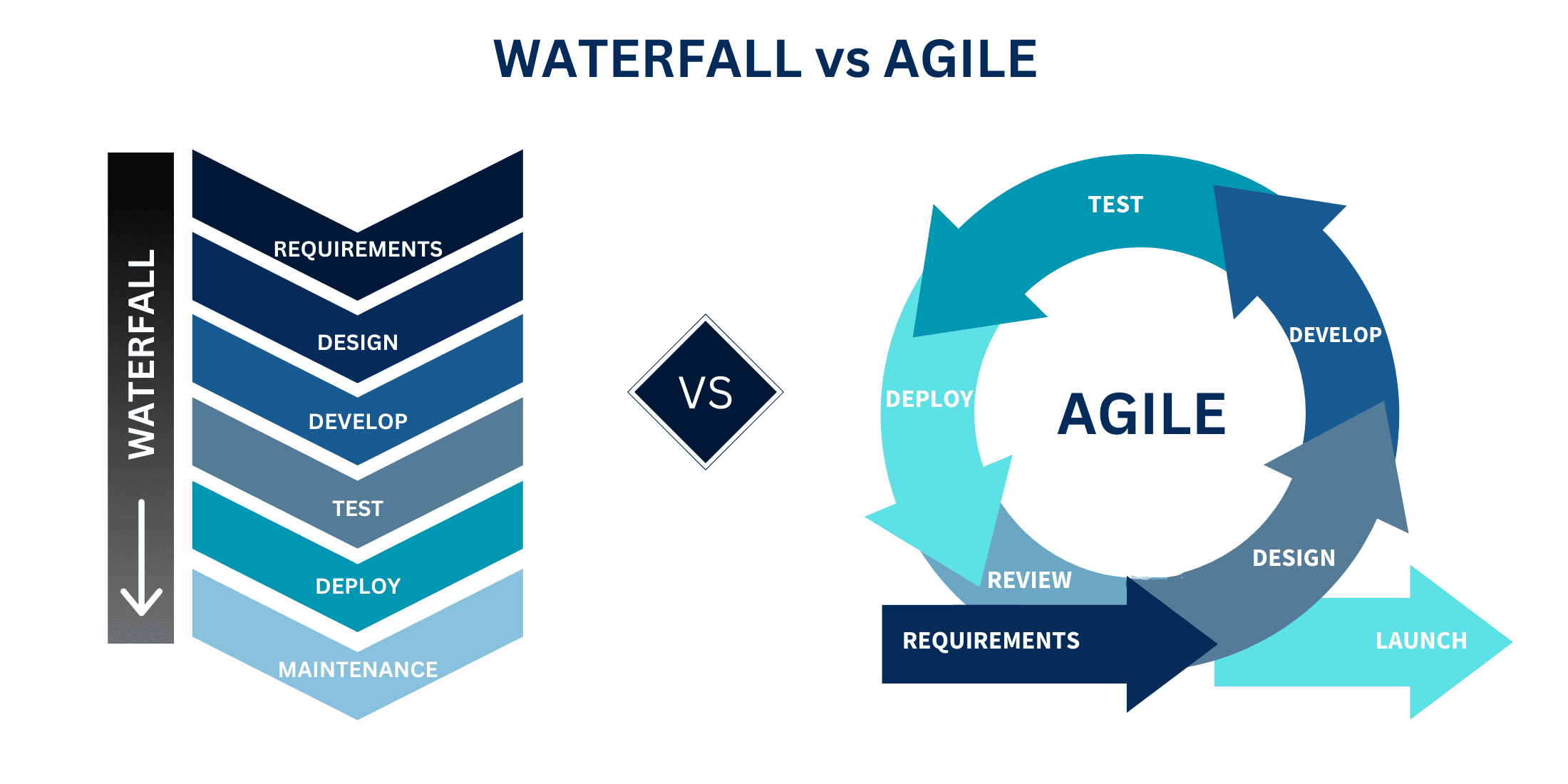
Agile and Waterfall are two different software development methodologies, each with its own approach to project management and software delivery. Waterfall is a traditional sequential approach to software development, while Agile is an iterative and incremental approach. It’s not a common scenario to use Agile in a pure Waterfall model, as they have fundamental differences. However, there are some instances where elements of Agile may be incorporated into the Waterfall model to increase efficiency and collaboration and vice- versa.

For example, our teams use Agile practices, such as daily stand-up meetings, retrospectives, or user stories, to facilitate communication and transparency within a Waterfall project. Additionally, Agile methodologies such as Scrum or Kanban could be used to manage individual project phases, such as development or testing, within a Waterfall framework.

Saying that, it’s important to note that incorporating Agile practices into a Waterfall model does not make it a true Agile methodology, but rather a hybrid approach that can potentially improves project outcome.

While the waterfall model has been widely used in the past, it is not always the best choice for software development projects. Few major problems of running Waterfall are:

  • Changing requirements: Requirements can change as the project progresses. With the waterfall model, changes may be difficult or impossible to make once a phase has been completed. This can lead to a product that does not meet the customer’s needs.
  • Delayed feedback: Because testing is only performed at the end of the development cycle, feedback on the product is not received until very late in the development process. This can lead to problems being discovered too late to be easily fixed.
  • High risk: Since testing is only performed at the end of the development cycle, any defects or issues that are discovered may require significant rework, which can be time-consuming and costly.
  • Limited customer involvement: The waterfall model typically involves limited customer involvement during the development process, which can lead to a product that does not meet the customer’s needs.
  • Time-consuming and expensive: The waterfall model can be time-consuming and expensive, as each phase of the project must be completed before moving on to the next phase. This can lead to delays and cost overruns.
  • Inflexible: The waterfall model is a rigid approach, with no room for changes once a phase has been completed. This lack of flexibility can be a problem if requirements change, or if a problem is discovered later in the development process.

Overall, while the waterfall model may be appropriate for certain types of projects, it is important to consider other software development life cycle (SDLC) models that may be better suited for the specific needs of the project.

As the way we work continues to evolve, organizations face the challenge of selecting the most suitable project management methodology for their unique needs. While Scrum and Waterfall have their merits, the Agile approach offers a comprehensive and flexible framework that enables organizations to adapt to change, collaborate effectively, and deliver value consistently. By embracing Agile methodologies, organizations can transform the way they work and navigate the ever-changing business landscape with confidence.

Co-Lending : India’s Watershed Moment in MSME Lending Business

India is home to more than 60 million MSMEs and contribute close to 30% of GDP. Yet, you ask any shopkeeper down the street, and they will tell you the hardships of finding an affordable credit. The high cost of finance particularly during pandemic have driven so many MSMEs out of business. Many small business owners still rely on cash-based usury loans at exorbitant high rates and are not part of the financial system.

RBI was aware of the liquidity crunch that exists in this business and as a solution introduced an innovative lending mechanism called Co-Lending in Nov 2020.

In fact, Co-Lending has all ingredients to be become the panacea for the India’s MSME credit issues if executed correctly.

 
What Exactly is Co-Lending?                  

Co-Lending is a lending practice where 2 lenders come together to issue a loan to a priority sector like MSME. First lender can be a bank and the second lender can be an NBFC or HFC (Housing Finance Company).

As per RBI’s Co Lending Model (CLM), banks can contribute 80% of the loan amount while the NBFC can contribute the remaining 20%. NBFC will take care of the sourcing of customers and the collection activity. The risk and reward are shared to the proportion of amount contributed by each lender. Customer will have a single loan agreement where contribution from both lenders will be listed clearly.

For Example, if a MSME customer wishes to borrow 1 lakh, bank can contribute 80,000 and NBFC can contribute 20,000. Bank expects 8% interest and NBFC expects 10%.

In this case, customer will be asked to repay the loan at 8.4% which is a weighted average.

Co-Lending Operating Mode :              

CLM Framework address below aspects in Co-Lending

Non-Discretionary loans – Bank can choose to outsource the sourcing activity by NBFC where all loans initiated and appraised by NBFCs will be taken in its books that meet the Co-Lending framework standard.

Discretionary loans Bank can cherry pick the loans initiated by NBFC. This means the credit appraisal process will be carried out by the bank. NBFC and bank can agree to transfer the whole amount of loan to bank as part of direct assignment (without any minimum holding period)

Both the lenders will have to enter into master agreement which has an agreeable framework on the responsibilities of each lender for sourcing, monitoring, recovery, and securitisation of loans.

Joint Responsibilities of Each Co-Lender:
  • Both the lenders must individually maintain the accounts of the customer on their books.
  • All transactions between the lenders should happen through an escrow account. Accounting and regulatory reporting as per the RBI regulated norms
  • Asset Classification and NPA provisioning should be handled to the proportion of loan exposure
  • Follow business continuity standards and practices like other loans.
Responsibilities of NBFC In a Co-Lending Deal :
  • NBFC will be the single point of contact for customers and necessary details of funding (lender and co-lender’s share) and inclusive interest will have to be explicitly made available in loan agreement. This includes sending regular loan statement to the customers.
  • NBFC will be responsible for ensuring KYC compliance of customers.
  • All customer complaints will have to be addressed within 30 days by NBFC, failing which the customer can approach banking ombudsman for grievance redressal.

Co-Lending is a win-win proposition for banks and NBFCs in addition to enabling affordable credit to MSME customers.

Benefit for Banks :                                           
  • Ability to reach the grassroot level customer/customer segment where bank – branch presence is not available.
  • Cost of customer acquisition is cheaper as the sourcing process is largely digital.
  • Achieve priority sector targets more easily.
Benefit for NBFCs :                                           
  • Expansion of customer base resulting in a diversified portfolio.
  • Risk and exposure shared only to the proportion of amount lent as part of co-lending deal.
  • Reduced capital adequacy needs as part of co-lending instead of allocating full capital on self-funded loans.

 
How Technology Can Help in Co-Lending 
  • Technology can play a crucial role in success of co-lending through digital customer onboarding and AI-ML based credit underwriting.
  • Aadhaar and PAN based e-KYC authentication coupled with OCR technology has reduced onboarding time drastically these days.
  • Lending solutions today can perform internal credit scoring as well as integrate with external bureau to get the credit score.
  • AI based models help in analyzing the solvency of customer and predicting loan defaults beforehand. In short, the whole credit appraisal process has become easy with the help of technology.
  • EMI Schedule generation needs to be generated separately for lender 1, lender 2 and the borrower. This can be automated by a strong co-lending software solution.
Towards a Bright Future :                                

Co-Lending has all qualities to bring the informal MSME segment into the financial system through an affordable credit policy. Soon, Co-Lending model will be widely accepted and become mainstream business of NBFC. The spread of co-lending is expected to expand beyond the rails of priority sector lending in India.

The Co-lending market is ripe for harvesting and we could see instances of Co-lending platforms disbursing loans worth Rs 5,000 crore in FY22.  Very soon, the Co-Lending market is expected to make loan disbursements worth 10,000 crores.

Choosing the right technology partner plays a significant role in the success of co-lending. Please reach out to our team if you are interested.  

Mr. Siva Kumar, CEO Asia – Interview with CEO Insights

Craft Silicon- a technology service provider for financial institutions serving over 300 organizations spanned across more than 30 countries. Along with the growth, the company has maintained an employee friendly work culture that led to being certified as ‘Great Place to Work’.

Siva Kumar, CEO of Craft Silicon Asia, with his astute business acumen and empathetic leadership has supported the team to be instrumental behind the organization’s successful growth and positioning across the Financial Inclusion domain.

” At Craft Silicon, we believe the vision, mission and core values lie within every employee, and that’s how we are a great place to work. “

He brings with him a wealth of experience in Information Technology, Banking, and Microfinance. Having been associated with Craft Silicon, Kenya since 2000, he has held several leadership positions along his tenure leading to his appointment as the current CEO.

In an exclusive interaction with CEO Insights, Siva has shed some light on the employee engagement at Craft Silicon that makes it a great place to work while offering abundant growth opportunities.

How would you define Craft Silicon as an organization and its position in the market?

Craft Silicon is a leading Core Financial System solution provider in the global market. It possesses a rich domain knowledge and a client-centric approach, and it is why the company holds over 40 percent market share in the small Finance Bank segment. Also, the company has a track record of having supported over two billion transactions, $7.4 billion Portfolio outstanding and around 77 million- end customers in 2021. Our mobility applications are robust & scalable to support loan origination, collection, disbursement, delinquency management, analytics and end borrower engagement while covering entire lending value chain.

Tell us about the exposure that your company offers to its employees. Also, what’s the unique work culture followed there?

I believe, work culture is the basic foundation of every organization to attract better talent and more importantly to retain that talent. Hence, we, at Craft Silicon build a workplace where the team understands their role in enabling the technology to accelerate
financial inclusion and inspire each other to work better.

Being a technology service provider, we support lending institutions to enable financial inclusion that acts as a key driver of sustained economic growth by ensuring adequate credit access to unbanked/ underbanked sections and drawing low-income groups
into the formal framework of the banking. Also, we never hold back on making our workplace fun with learning which is the perfect antidote to monotony. We ensure that every employee of our organization feels respected, secured, empowered with right product knowledge, approachable to leadership and be innovative.

Reflect on the unique aspects of your HR policy. What are the growth opportunities and recognition the employees can expect from the organization?

We at Craft Silicon have the most simplified HR Policies that are artistically crafted and in line with the needs of the employees, per se the current environmental concern. Also, the policies here are not enforced on the employees, instead they’re educated on why an organization is bound by such norms. We do so by explaining purpose during the Induction and having a Policy Training and assessment annually to
emphasize the need of such HR Policies.

We also differ in the growth opportunities for employees at Craft Silicon as we don’t have a soak in period for next promotion cycle for our employees here, instead once the talents are identified we immediately expose them to the growth opportunities and encourage them to the right career progression.

What does Craft Silicon expect from new candidates in terms of attitude, work ethics, and talent, among others?

At Craft Silicon, we prefer our new candidates to enjoy the work, understand the impact they are creating within the organization and understanding the customers’ business growth while maintaining professionalism, long term potential growth, teamwork, collaboration at
workplace, being enthusiastic, passionate, and implying critical thinking approach.

What are the ways of recognizing top talents & great performances within the organization?

We help our employees to assess their strong areas and create the platform to perform and excel in their core competencies. We also provide multiple opportunities to explore their interests in across departments for overall exposure conducting regular workshops (to improve leadership skills, empathy, and team collaboration), and once the talents are recognized we expand their learning & development
opportunities, Acknowledge, Recognize and Celebrate their achievements continuously.

Mobile Solutions To Accelerate Financial Inclusion

Mobile Solutions to accelerate Financial Inclusion : Microfinance is an industry that bridges the gap of economic inequality by lending loans to the unbanked/underbanked that benefit them in building their assets, creating new business opportunities and having a sustainable lifestyle. Being a guardian angel of the economically challenged, Microfinance fosters financial inclusion to alleviate poverty in India.

Furthermore, Internet and mobile penetration has led to the evolution of technology in the microfinance sector. However, the limited financial proficiency and formal training in rural India poses specific challenges in Microfinance operations. With the new RBI guidelines, technology (Mobility Solutions) now plays a major role in scalability, acquiring the increased target market and gaining competitive advantage through customized solutions.

Mobile Solutions for Financial Institutions

Digitization in the microfinance sector gave birth to mobility solutions that contribute to the accomplishment of financial inclusion.

Mobile solutions bring many stumbling blocks at ease. It reduces the operational costs by collecting data entirely through mobile devices, builds customer loyalty through better user experiences, empowers microfinance industries to reach out to more people and function in a uniform and organized manner.

Accelerates access of financial services in remote areas, understanding customers’ needs and behavior and upskilling people of rural India.

Craft silicon ~ Fulfilling the vision of financial inclusion  

we bring you the array of mobile solutions to combat all the challenges of field operations and expedite the aim of financial inclusion. These solutions help in improved decision making, reduction of default rates and expenses, thereby bridging the communication gap to enhance productivity.

Let’s explore craft silicon product suite that is created to envelop the entire microlending process from loan management to disbursement, collection, and delinquency management.    


GLOW

Abbreviates to group loan organization flow is a comprehensive software that has various inbuilt features that are beneficial to MFIs. Starting with village surveys, geo-location tagging, capturing demographics data and eKYC,  it enables automated field credit verification and appraisals, centralized data management, quality check for easy loan disbursements.


ILOS

Individual loan origination workflow automates the lending process by allowing the lenders to promote loan products through geo-tagging feature, seamless data entries, reference checks and loan utilisation plans.


TRUCELL

Trucell is a mobile application specifically designed to support and empower Microfinance field operations. It facilitates the lending operations for optimum loan collection, loan disbursement, Loan Utilisation payments, pre-closure, demise marking and other e-services through mobile devices. Trucell hosts a range of functions and activities to make work easier, quicker, and efficient for field officers.


TRACKOD

TrackOD supports in managing default accounts, overdue loans, partial collection, fore-closure, on-field loan settlement and write off recommendations digitally.


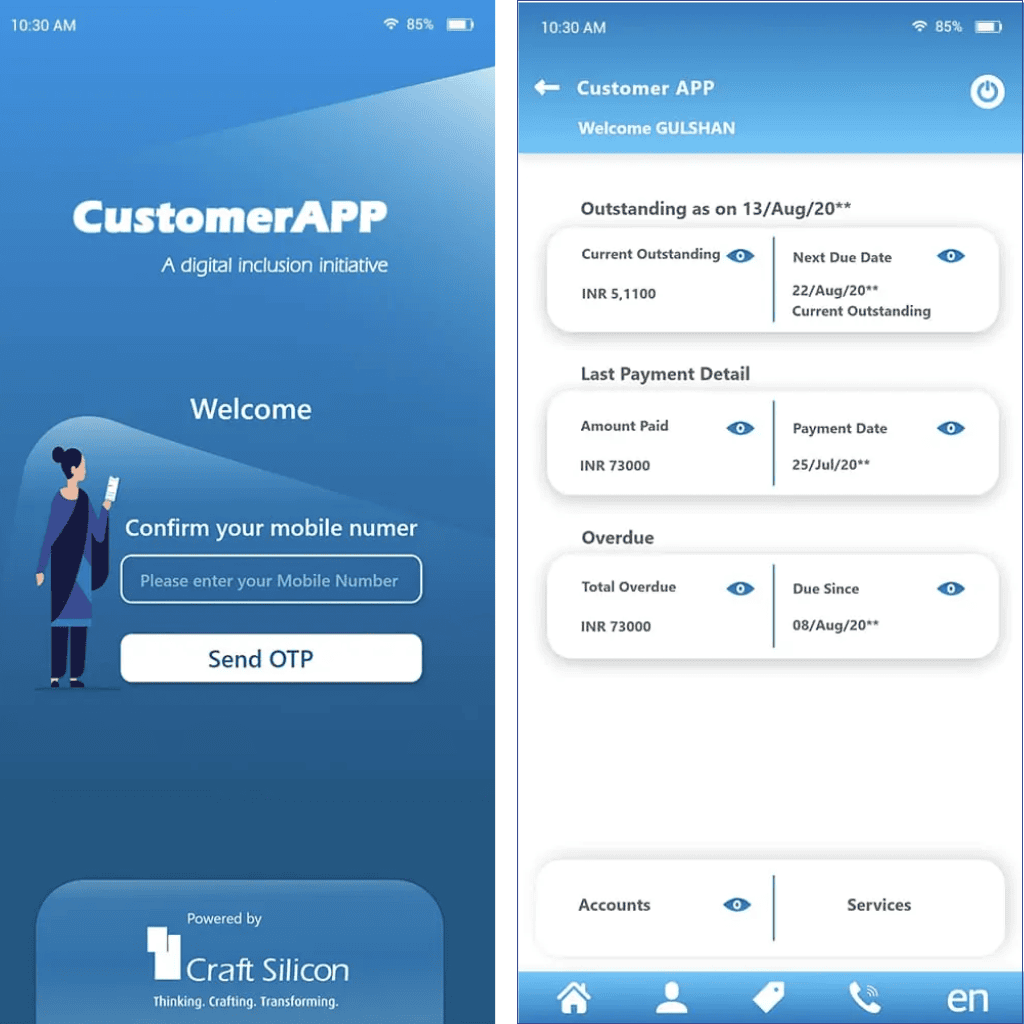
CUSTOMERAPP

Customer app helps the end borrowers by providing a user-friendly interface for MFIs customers that facilitates access to loan information, loan status alerts, new offers etc. in their regional language settings.

Craft silicon provides integrated low-cost digital tech mobility tools to lenders and borrowers and thereby, accelerate the growth of financial inclusion in India. This mobile initiative will fathom a lot of interrelated issues like literacy and unemployment, thus curbing poverty on a large scale!

Technology – Abetting Women Leadership

Women from every stratum without any identity margin are self-calibrating to be business leaders, enabling them to demonstrate their business attributes without the prerequisite of academia or experience.

Women are confidently soaring broadening their horizons by taking crucial financial decisions for themselves and their families beyond the kitchen.

My spotlight is on the rural women sector and women coming from a low-income background. Their audacity to outset a business brought a remarkable revolution of women empowerment.

No! Am not bringing the facet of gender diversity, however, the multitudinous inclusion of, women, men, and financial institutions has created an arena for women to transform their life holistically by generating income through their business activity to aim at providing a better life for their family.

Micro Finance Institution is the phenomenon that has turned the table by creating an opportunity to take a loan to change their dream to reality by pulling them out from midlife blues and re-directing towards entrepreneurship. The implication of this is trending in the rise of women leaders in business society without bars.

Craft silicon and fraternity of microfinance institutions provide automation mechanisms to enhance the performance and further, it simplifies the operations of financial institutions also contributes towards women’s entrepreneurship and financial inclusion. Craft silicon has robust technology with an apt blend of creativity and innovation for a trouble-free loan process with seamless integration, diverse features to manage the end-to-end loan process.

Craft silicon product suite ushers positive evolution in solving problems of banks and their staff. For instance, logistic issues, problems of wastage of paper, saving Transaction and documentation time intending for short turnaround time for disbursement.

This is rapidly aiding in solving the money crunch of women leaders. Craft silicon is one of the sturdy pillars supporting women’s leadership with a range of solutions contributing towards women’s leadership.

Women as business leaders become strong role models for their kids. They possess attributes such as:

  • Women balance work and life Women leaders balance kids and families with their business, so they have learned to multitask and set priorities, and they encourage other women to do the same.
  • Empathy is their strength – Women are high on empathy. This strength allows them to build and nurture relationships in their business, and it helps them understand their customers and make them feel valued.
  • Women leaders are good interactors Women leaders are good at initiating small talks. They build bonding with others quickly. This skill helps them to persuade, negotiate and also have colloquial relationships amongst their stakeholders.
  • Women leaders are emotionally intelligent Women leaders have the blessing of managing their emotions and others’ emotions well. They are emotionally strong, which aids in handling stressful activities. They are adaptable to the situation and can mindfully take action steps during a difficult situation.
  • Women leaders handle situations well Critical thinking and analyzing are of strength in women. Women handle crises well even during difficult situations they look for resources to handle the issue. Women leaders confidently take risks for themselves and their family welfare.