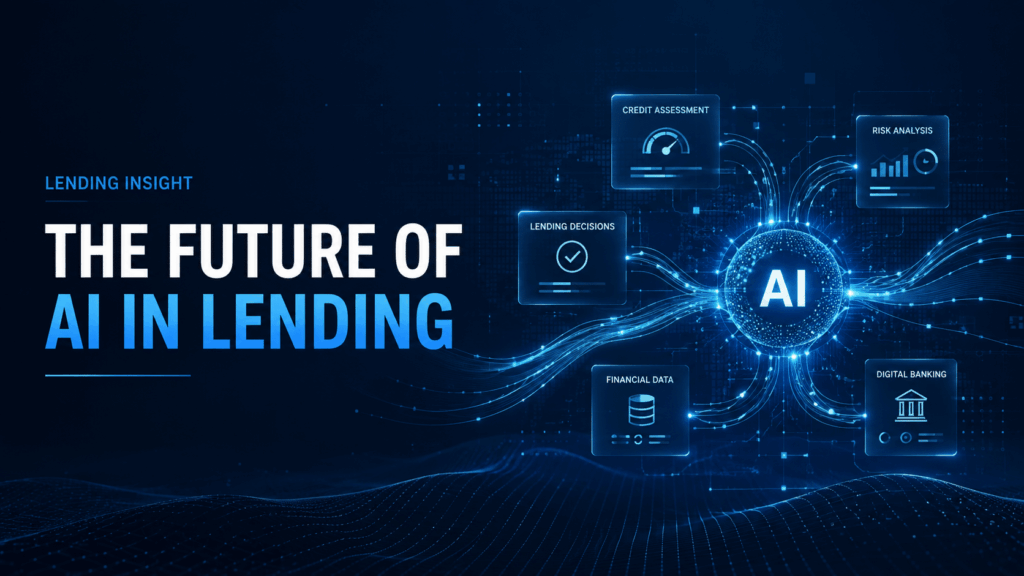
The Future of AI in Lending

Who should get credit? How much should they receive? At what price? What signals suggest that a borrower may struggle later?

For decades, these decisions have relied on credit scores, financial statements, rules, human judgement, and increasingly sophisticated technology. AI is now changing how those pieces work together.

But the future of AI in lending is not simply about replacing manual decisions with algorithms. The bigger opportunity is to build lending systems that can understand more data, respond faster, identify risk earlier and give people better information when they need to make a decision.

That shift is already underway.

From automation to intelligence

Lending technology has already automated many repetitive activities, from application processing and document handling to workflow management and customer communication.

AI takes this a step further.

Instead of simply following a predefined rule, machine learning models can identify patterns across large and diverse datasets. This can help lenders assess creditworthiness, detect unusual behaviour, predict portfolio risks and prioritise cases that need attention.

Research from Experian’s 2025 study of 109 senior credit-risk decision makers in India illustrates the direction of travel. Among lenders using machine learning, 68% cited improved risk-prediction accuracy and operational efficiency as key benefits, while 71% said ML enabled greater automation of credit decisions.

This matters because lending volumes are growing, borrower profiles are becoming more diverse, and traditional methods do not always provide enough information to make a timely decision.

AI could change credit decisioning

Credit underwriting is likely to remain one of the most important areas for AI in lending.

Traditional credit assessment often depends heavily on established credit histories and structured financial information. That works well for customers with a strong financial track record, but it can be less effective for new-to-credit customers or borrowers with limited histories.

AI can analyse a broader range of relevant information and identify relationships that may not be obvious through conventional methods.

This could help lenders assess thin-file customers more effectively and expand responsible access to credit. In Experian’s India research, 79% of ML adopters said the technology allows them to responsibly serve new customer segments that traditional scorecards can sometimes exclude.

There is also an important human element here.

A recent BIS working paper examining AI and relationship lending found that AI-based credit screening can coexist with relationship-based lending rather than simply replacing it.

That points towards a more practical model for lending: technology handles scale and pattern recognition, while human expertise remains important where context and judgement matter.

The next opportunity is beyond underwriting

AI’s impact will not stop when a loan is approved.

The lending lifecycle creates opportunities at almost every stage.

1. Smarter onboarding

AI can help extract information from documents, identify inconsistencies, classify applications, and reduce repetitive manual work.

The result is a faster journey for both the borrower and the operations team.

2. Better fraud detection

Fraud rarely follows a single predictable pattern. AI can analyse transaction behaviour and identify unusual combinations of signals that may indicate suspicious activity.

The RBI itself has been exploring AI-based fraud prevention. Its MuleHunter.AI initiative is designed to help identify mule bank accounts, with pilots at two large public-sector banks showing encouraging results.

3. More proactive portfolio management

One of the biggest advantages of AI may be the ability to identify risk before it becomes a visible problem.

Instead of waiting for a missed payment, lenders can look for changes in behaviour and other early-warning signals.

That creates the possibility of moving from reactive collections to more proactive portfolio management.

4. More intelligent collections

Collections can become more targeted.

AI can help determine which accounts need immediate attention, which customers may respond better to a particular communication approach, and where human intervention is most valuable.

The goal is not simply to contact more borrowers. It is to make each intervention more informed.

5. Better customer experiences

AI-powered assistants can handle routine questions, provide status updates and support customers outside traditional working hours.

But good lending experiences will still depend on transparency. Customers need to understand what is happening with their application, what they are being offered and, particularly in credit decisions, why a decision was made.

Generative AI will change the work around lending

Generative AI introduces another layer to the conversation.

Its biggest near-term value may not necessarily be making the final credit decision. Instead, it can help the people who design, operate and oversee lending processes.

Think about the amount of information involved in a modern lending operation: policy documents, credit reports, customer records, regulatory requirements, exception reports, model documentation and portfolio data.

GenAI can help teams search, summarise, compare and interpret this information much faster.

Experian’s research found that 84% of respondents believe GenAI can significantly reduce the time required to develop and deploy credit-risk decisioning models. Seventy percent also identified regulatory documentation as an area where GenAI could streamline work.

That could have a meaningful effect on productivity, particularly for risk, credit, operations and compliance teams.

But faster does not automatically mean better

This is where the conversation around AI in lending needs to become more serious.

A model can be fast and still be wrong.

It can be accurate on historical data and perform poorly when customer behaviour changes. It can reproduce biases hidden in the data used to train it. And increasingly complex models can make it difficult to explain why a particular decision was reached.

The BIS has highlighted explainability as a major challenge for financial institutions, particularly when complex AI and generative AI systems are used in credit underwriting.

For lenders, this is not just a technical issue. It is a governance issue.

If an AI-assisted system rejects a loan, flags a customer or changes a risk assessment, the institution still needs to understand the decision and be able to explain it appropriately.

The responsibility does not disappear because a machine made the recommendation.

India is already moving towards responsible AI

India’s regulatory environment is also evolving alongside the technology.

The Reserve Bank of India established the committee for a Framework for Responsible and Ethical Enablement of AI, or FREE-AI, recognising both the potential benefits of AI and risks involving areas such as bias, explainability and data privacy.

The RBI has also emphasised the importance of accurate and diverse data, auditability, transparency and customer protection when AI and ML are used in lending.

This is an important signal for financial institutions.

The question is no longer simply:

Can we use AI?

It is becoming:

Can we use AI responsibly, transparently and at scale?

The future will be AI-assisted, not AI-only

The most successful lending institutions are unlikely to be the ones that automate everything.

They will be the ones that know what to automate, what to augment, and where human judgement should remain in control.

AI can process enormous amounts of information. Humans can understand context, challenge assumptions and take responsibility for difficult decisions.

Put the two together, and the opportunity becomes much bigger.

A modern lending ecosystem could continuously learn from portfolio behaviour, identify emerging risks, automate routine work, support employees with better insights and give customers faster, more relevant experiences.

That is a very different proposition from simply adding an AI feature to an existing lending platform.

Building the lending stack for what comes next

The future of AI in lending will also depend on the infrastructure underneath it.

AI needs quality data. It needs connected systems. It needs APIs, workflow orchestration, model monitoring, security, and governance. And it needs a clear way to bring human oversight into the process.

Without that foundation, AI can become another disconnected layer on top of already fragmented lending operations.

With the right foundation, it can become part of the lending lifecycle itself.

The future of lending is not about AI making every decision. It is about creating a lending ecosystem where technology helps institutions make better decisions, earlier, with greater visibility and stronger control.
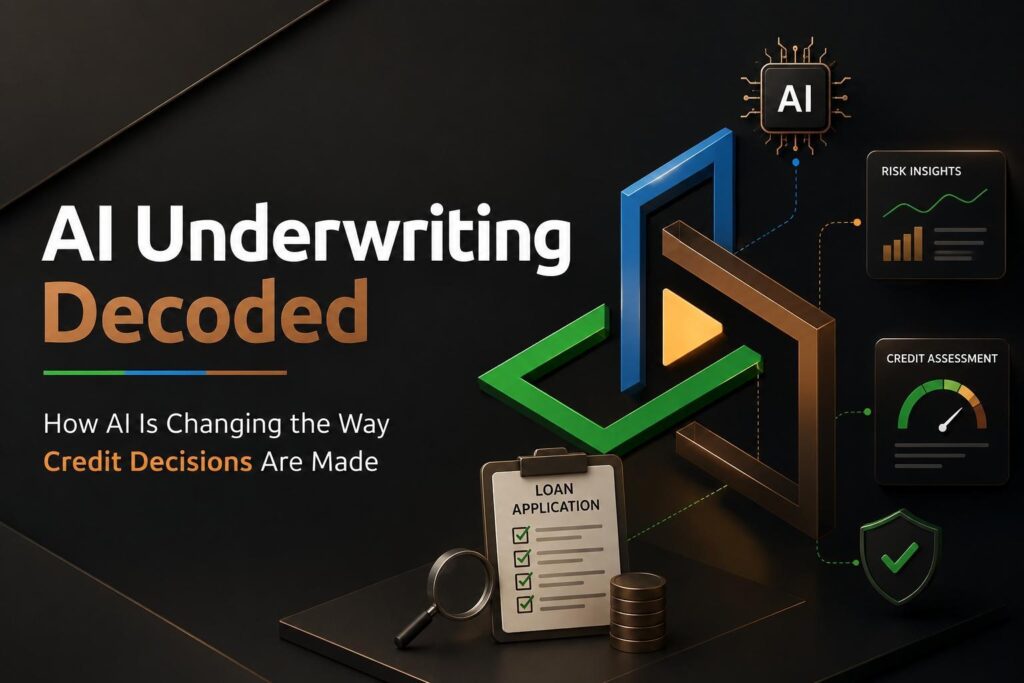

 

AI Underwriting as a Copilot: The Next Evolution of Intelligent Lending

AI is changing the way financial institutions assess credit, but the future of underwriting is not about replacing underwriters. It is about giving them a smarter copilot.

Lending has always depended on one fundamental question:

Can this borrower repay?

Answering that question, however, has never been simple.

A credit underwriter may need to examine loan applications, financial statements, bank statements, credit bureau information, KYC records, business performance, cash flows, collateral, repayment behaviour and other supporting documents before arriving at a decision.

As lending volumes increase, the challenge is no longer simply having access to data. It is making sense of that data quickly, consistently and responsibly.

This is where AI underwriting is beginning to change the lending landscape.

But the future of underwriting is not necessarily about replacing the underwriter with an algorithm.

It is about giving the underwriter a copilot.

An AI underwriting copilot can bring together information from multiple sources, identify patterns, highlight inconsistencies, summarise borrower information, surface potential risks and provide decision-support insights, while keeping the final responsibility with the human decision-maker.

Human expertise + AI intelligence + digital lending infrastructure.

What Is an AI Underwriting Copilot?

An AI underwriting copilot is an intelligent decision-support layer that assists credit and lending teams throughout the underwriting process.

Instead of making the underwriter manually move between multiple documents, systems and data points, the copilot can help organise the information into a structured view.

For example, when a business applies for a loan, an AI-enabled underwriting system could help:

  • Extract relevant information from financial and supporting documents
  • Identify missing or inconsistent information
  • Summarise the applicant’s financial position
  • Analyse income and cash-flow patterns
  • Highlight unusual transactions or potential risk indicators
  • Compare information across multiple documents
  • Surface relevant credit and repayment indicators
  • Identify cases that require additional investigation
  • Generate an initial credit assessment for human review
  • Explain the factors contributing to a particular risk assessment

The important distinction is that the AI is not simply producing a yes-or-no answer.

It is helping the underwriter see the application more clearly.

Why Traditional Underwriting Needs a New Approach

Traditional underwriting has evolved significantly through digitisation, but many lending processes still involve considerable manual effort.

An underwriter may receive a large borrower package containing financial statements, bank statements, tax documents, identity documents and other supporting records.

The information may be spread across different formats and systems.

When application volumes increase, these challenges become even more visible.

Financial institutions may face:

  • Longer turnaround times
  • Repetitive document analysis
  • Manual data entry
  • Multiple system interfaces
  • Inconsistent interpretation of information
  • Difficulty identifying subtle risk signals
  • Increased pressure on experienced underwriters
  • Higher operational costs

Digital loan origination systems can automate many of these processes.

The next step is to make those systems more intelligent.

That is where AI underwriting becomes particularly relevant.

From Automated Rules to Intelligent Decision Support

Automation is not new to lending. Business rules engines, credit policies, scorecards and workflow automation have already transformed loan processing.

Rules can determine whether an application meets predefined conditions.

AI introduces another layer of capability.

Instead of asking only:

Does this application meet the rule?

AI can help lenders ask:

What does the available information tell us about this application?

A rules engine is excellent at applying defined policies consistently. AI can help interpret complex information, detect patterns and prioritise areas that deserve human attention.

Rules provide control.

AI provides intelligence.

Underwriters provide judgement.

This combination can create a more responsive underwriting environment without removing the governance and accountability required in financial services.

How an AI Underwriting Copilot Could Work

Imagine a business loan application arriving at a lender. The application contains financial statements, bank statements, tax information, credit bureau data and other supporting documents.

Instead of asking an underwriter to manually review every piece of information from the beginning, an AI-enabled workflow could first organise and analyse the available information.

1. Data and Document Understanding

The system can identify relevant information across structured and unstructured documents. Revenue, expenses, liabilities, repayment obligations and other financial indicators can be brought into a structured view. This can reduce repetitive manual data extraction and allow underwriters to spend more time on analysis and judgement.

2. Information Validation

AI can help identify inconsistencies. For example, information declared in an application may differ from information found in supporting financial documents. Rather than making the underwriter search for these discrepancies manually, the system can flag them for review.

3. Financial Analysis

The copilot can help analyse financial trends, cash flows and other relevant indicators. For an MSME borrower, understanding the movement of cash flow can provide important context beyond a single credit score. This can help lenders develop a more contextual view of borrower risk.

4. Risk Signal Identification

The AI layer can surface potential risk indicators for the underwriter. These could include unusual financial movements, inconsistencies, repayment concerns or other patterns that require deeper investigation. The goal is not to hide complexity. The goal is to make important signals easier to find.

5. Decision Support

Once the information is organised, the copilot can generate an underwriting summary for the credit professional. The underwriter can then review key financial indicators, positive signals, risk indicators, missing information, policy exceptions, relevant supporting evidence and areas requiring further investigation.

This changes the role of the underwriter from information processor to decision-maker.

The Human Still Matters

This is perhaps the most important part of the AI underwriting conversation.

Financial decisions have consequences. A loan approval affects a lender’s risk exposure. A rejection can affect a customer’s business, livelihood or growth plans.

For this reason, AI in lending cannot simply be treated as a black-box automation exercise.

The future of responsible AI underwriting depends on human oversight, explainability, accountability and appropriate governance.

The word copilot matters.

A copilot supports the person operating the system. It does not remove the person from the process.

The objective is not: Human OR AI

It is: Human + AI

Explainability Is Not Optional

One of the biggest challenges associated with AI underwriting is the black-box problem.

If an AI system produces a risk assessment, the lender needs to understand what influenced that assessment.

A useful underwriting copilot should therefore move beyond:

Risk: High

and provide useful context such as:

  • Why was the risk assessed this way?
  • Which factors contributed?
  • Which data points were important?
  • Were there inconsistencies?
  • Were there missing documents?
  • Did cash-flow behaviour change?
  • Was a particular policy condition triggered?

It is part of building trust, governance and auditability.

AI Underwriting and Financial Inclusion

Traditional credit assessment can struggle with borrowers who have limited conventional credit histories. This can include first-time borrowers, small businesses and segments where financial information is less standardised.

AI can potentially help lenders analyse a broader range of permitted and relevant information and identify creditworthy applicants who might otherwise be difficult to assess.

AI underwriting could help lenders assess more borrowers without necessarily lowering underwriting standards.

The objective is not to approve more loans blindly.

It is to make better-informed decisions at scale.

The Role of AI in MSME Lending

MSME lending is one area where AI-assisted underwriting could have a particularly meaningful impact.

Small businesses often operate with complex and highly variable cash-flow patterns.

A traditional assessment may not fully capture the nuances of a business simply by looking at a credit score or a limited set of financial indicators.

For lenders, this could support:

Better assessment → Faster processing → More informed decisions → Broader access to credit

For financial institutions serving MSMEs, the ability to combine cash-flow intelligence, credit information and automated analysis can become an important part of building scalable lending operations.

Where AI Underwriting Fits Into a Modern Lending Stack

AI should not exist as an isolated tool sitting outside the lender’s core technology environment.

The real value comes when intelligence is connected to the existing lending ecosystem.

Customer / Channel
↓
Digital Loan Application
↓
KYC & Data Verification
↓
Document Intelligence
↓
Credit Bureau & Financial Data
↓
Business Rules Engine
↓
AI Underwriting Copilot
↓
Human Underwriter / Credit Manager
↓
Loan Decision
↓
Disbursement & Loan Management

The future of lending is not about adding another disconnected technology layer. It is about connecting intelligence across the lending lifecycle.

AI Underwriting Is Not the Same as Fully Automated Lending

There is a tendency to assume that the end goal of AI is complete automation. In financial services, that may not always be the right objective.

A better question is: Which parts of underwriting should machines handle, and where should human expertise remain essential?

AI can assist with Humans can focus on
Document analysis Complex judgement
Data extraction Exceptions
Pattern identification Policy interpretation
Risk signal detection Final assessment
Application summarisation Business context
Consistency checks Accountability

The future is therefore less about human versus AI and more about human with AI.

The Governance Challenge

The more important AI becomes in lending, the more important governance becomes.

Financial institutions need to consider:

  • Data quality
  • Data privacy
  • Model validation
  • Bias and fairness
  • Explainability
  • Cybersecurity
  • Auditability
  • Human oversight
  • Model performance monitoring
  • Third-party AI dependencies

Do not deploy AI simply because it is possible. Deploy it where it can be governed, measured and trusted.

Responsible AI underwriting requires technology and governance to evolve together.

What the Future of Underwriting Could Look Like

The underwriting process of the future may feel very different from today’s workflow.

Instead of opening multiple systems and manually reviewing hundreds of pages, an underwriter could begin with an intelligent workspace.

The system could show:

• Applications requiring attention
• High-priority risk signals
• Missing information
• Policy exceptions
• Applications ready for review
• Changes in portfolio-level risk patterns

The underwriter could then interact with the system using natural language.

• What are the key risks in this application?
• Which financial indicators changed significantly?
• Are there inconsistencies across the submitted documents?
• What information should I verify before approving this application?
• Summarise the reasons supporting and challenging the application.

The AI responds using the available and authorised information, while the underwriter remains in control.

That is the real promise of an AI underwriting copilot.

Not replacing expertise.

Amplifying it.

The Next Competitive Advantage in Lending

For banks, NBFCs, microfinance institutions and other lenders, the next competitive advantage may not come simply from processing applications faster.

It may come from making better decisions with the same or greater speed.

AI can help lenders move toward a model where:

More data becomes more insight.
More insight becomes better decisions.
Better decisions become better lending outcomes.

Achieving that requires more than adding an AI model to an existing system.

Data + Lending Workflows + Business Rules + AI + Governance + Human Expertise

The Future Is Intelligent Lending, Not Blind Automation

AI underwriting is entering an important stage in the evolution of lending.

The technology can help lenders process information faster, identify patterns, reduce repetitive work and support more consistent decision-making.

But the most valuable implementation will not necessarily be the one that removes humans from the loop.

It will be the one that gives experienced credit professionals better information, better context and better tools at the moment decisions need to be made.

The future of underwriting is therefore not simply automated. It is augmented.

And the AI underwriting copilot could become one of the most important interfaces between technology and human judgement in modern lending.

For banks and financial institutions, the question is no longer only:

Can AI underwrite a loan?

The more important question is:

How can AI help our underwriters make better lending decisions?

That is where the next chapter of intelligent lending begins.

Building the Next Generation of Intelligent Lending

Craft Silicon brings together banking and financial technology expertise with platforms designed to support modern lending operations.

From loan origination and credit assessment to loan management, analytics and AI-driven insights, financial institutions can build lending journeys that are increasingly digital, connected and intelligent.

The future of lending is not about choosing between technology and human expertise. It is about bringing them together.

Think Technology in Banking. Think Craft Silicon.

The Rise of Digital Wallets: What Banks Must Do to Stay Relevant

Digital wallets are no longer just another tech trend; they’re quietly reshaping the very foundation of banking. The real shift isn’t about “apps replacing branches,” but about who truly owns the customer relationship in a world where most transactions begin with a tap on a screen rather than a visit to a branch. From my standpoint as a product trainer, the transformation is very clear. Customers no longer ask how to use net banking. Instead, their questions revolve around failed UPI transfers, adding cards to wallets, or the safety of scanning a QR code at an unfamiliar store.
The day-to-day banking conversation has moved squarely into the wallet and payments ecosystem, whether banks choose to acknowledge it or not. Yet many banks still treat this space as an add on rather than the core of customer engagement. The bigger risk for banks isn’t losing customers overnight, it’s becoming invisible. When someone uses a big-tech wallet multiple times a day, that wallet becomes the brand they see, trust, and interact with, even though their money still lives in a bank account. And once the wallet begins offering its own cards, credit lines, or savings products, the bank slips further into the background. It still carries the responsibilities, but it’s no longer the customer’s first point of contact. That imbalance should worry every banking leader.


 

So, what can banks do realistically?

First, they must accept that digital wallets are now a primary channel, not an optional convenience. Journeys should be designed with the assumption that customers will start with a wallet for everyday spends, bill payments, and peer-to-peer transfers. And before chasing “super-app” dreams, banks must get the fundamentals right: dependable transaction success, transparent communication on limits and charges, and simple, predictable resolution when something goes wrong. Most customers aren’t looking for special features. They simply want assurance that their payment will either succeed or be reversed without delay. If customers have never witnessed a failed transaction, or never walked through a refund flow, their confidence will naturally be high. Customers immediately pick up on that.

Banks also need clarity on where to compete and where to collaborate. A mid-size bank cannot out-design the user interface of a global tech giant’s wallet, but it can excel in specific journeys such as salary credits, SME collections, or recurring payments by offering consistency, clarity, and well-prepared support. And when the bank serves as the backend rails for someone else’s wallet, its focus should be on reliability and compliance, not on forcing visibility that customers may not care about.

Ultimately, the future isn’t “wallets versus banks.” It’s “wallet-enabled banks” versus those stuck in a branch-centric mindset. Digital wallets are simply revealing who is ready to adapt and who isn’t. Banks that pair thoughtful product strategy with genuine investment in human capability and train their teams to think, speak, and operate in the digital wallet world will remain relevant. Those that treat wallets as a minor add-on may eventually realize that while their name still sits on the account, their relationship with the customer has silently slipped away. Failing to adapt is no longer an option, the future of banking will be defined by those who embrace the digital wallet revolution today.

Why Human-Centric Fintech Is at the Heart of Craft Silicon

Human-Centric Fintech at Craft Silicon

In the fast-paced world of financial technology, it’s easy to get lost in the buzzwords—AI, APIs, cloud-native, blockchain. But behind every line of code, behind every transaction, there’s one thing that matters more than anything else: people.

At Craft Silicon, we’ve never forgotten that. And we never will.


Human-Centric by Design, Not by Trend:

While others build for platforms, we build for people who use them—bank customers, loan officers, tellers, agents in the field, and the developers who keep financial systems running.

Being human-centric isn’t about soft talk. It’s about deep listening, solving for real problems, and building fintech tools that empower, not overwhelm.

We Build for the Real World:

Across Africa and Asia, millions of people interact with our platforms every day—sometimes on a smartphone in Nairobi, sometimes through an agent in a remote town in Uganda, or from a SACCO branch in Tanzania.

Our design principles are shaped by that reality:

  • Offline-first thinking for low-connectivity areas
  • Local language support where accessibility matters
  • Intuitive UIs for users who are new to digital banking
  • Configurable workflows for institutions that need to adapt fast

We don’t just digitize processes. We humanize banking.

Simplicity at the Core:

From our Nimble core banking platform to the SmallTalk, Spotit, and MySalary, we obsess over reducing friction. Because the best fintech doesn’t just work—it feels easy, even when solving hard problems.

  • A loan disbursement that takes 2 taps
  • A customer onboarding journey that finishes in 3 minutes
  • A mobile banking experience that doesn’t need a manual

That’s human-centric fintech.

We Co-Create With Clients:

Being people-first means working shoulder to shoulder with our partners—banks, SACCOs, MFIs, and fintechs—not just delivering software.

We host:

  • ECHO feedback sessions to capture real pain points
  • Design sprints with client teams to co-define product journeys
  • Regional onboarding that respects cultural and business nuances

It’s not just our UX that’s human-focused. It’s how we work, train, and support.

Technology With a Heartbeat:

We’re proud of our tech stack—cloud-native, modular, secure, and scalable.

But what makes Craft Silicon different is this:

We build with the heart of a human and the mind of a technologist.

We don’t just deliver innovation—we make it usable, inclusive, and kind.

Let’s Build the Future—For People:

As we move towards the next decade of digital finance, the winners won’t be the fastest or flashiest. They’ll be the ones who build with intention, inclusion, and impact.

At Craft Silicon, we’re proud to be more than just a fintech engine.

We are—and will always be—a human-centric force for financial change.

The Rise of Digital Wallets: What Banks Must Do to Stay Relevant

Digital wallets are no longer just another tech trend; they’re quietly reshaping the very foundation of banking. The real shift isn’t about “apps replacing branches,” but about who truly owns the customer relationship in a world where most transactions begin with a tap on a screen rather than a visit to a branch. From my standpoint as a product trainer, the transformation is very clear. Customers no longer ask how to use net banking. Instead, their questions revolve around failed UPI transfers, adding cards to wallets, or the safety of scanning a QR code at an unfamiliar store.

The day-to-day banking conversation has moved squarely into the wallet and payments ecosystem, whether banks choose to acknowledge it or not. Yet many banks still treat this space as an add on rather than the core of customer engagement. The bigger risk for banks isn’t losing customers overnight, it’s becoming invisible. When someone uses a big-tech wallet multiple times a day, that wallet becomes the brand they see, trust, and interact with, even though their money still lives in a bank account. And once the wallet begins offering its own cards, credit lines, or savings products, the bank slips further into the background. It still carries the responsibilities, but it’s no longer the customer’s first point of contact. That imbalance should worry every banking leader.

So, what can banks do realistically?

First, they must accept that digital wallets are now a primary channel, not an optional convenience. Journeys should be designed with the assumption that customers will start with a wallet for everyday spends, bill payments, and peer-to-peer transfers. And before chasing “super-app” dreams, banks must get the fundamentals right: dependable transaction success, transparent communication on limits and charges, and simple, predictable resolution when something goes wrong. Most customers aren’t looking for special features. They simply want assurance that their payment will either succeed or be reversed without delay. If customers have never witnessed a failed transaction, or never walked through a refund flow, their confidence will naturally be high. Customers immediately pick up on that.

Banks also need clarity on where to compete and where to collaborate. A mid-size bank cannot out-design the user interface of a global tech giant’s wallet, but it can excel in specific journeys such as salary credits, SME collections, or recurring payments by offering consistency, clarity, and well-prepared support. And when the bank serves as the backend rails for someone else’s wallet, its focus should be on reliability and compliance, not on forcing visibility that customers may not care about.

Ultimately, the future isn’t “wallets versus banks.” It’s “wallet-enabled banks” versus those stuck in a branch-centric mindset. Digital wallets are simply revealing who is ready to adapt and who isn’t. Banks that pair thoughtful product strategy with genuine investment in human capability and train their teams to think, speak, and operate in the digital wallet world will remain relevant. Those that treat wallets as a minor add-on may eventually realize that while their name still sits on the account, their relationship with the customer has silently slipped away. Failing to adapt is no longer an option, the future of banking will be defined by those who embrace the digital wallet revolution today.

From Complex to Nimble: How We’re Redefining Core Banking for the Next Generation

Nimble Core Banking PlatformIn today’s financial landscape, core banking systems are expected to do more than just “work.” They need to adapt, innovate, and scale—all without breaking the bank or the back office. Unfortunately, many institutions are still burdened with legacy systems that are rigid, siloed, and expensive to maintain. At Craft Silicon, we’ve been listening to our clients. From tier-one banks looking to modernize, to microfinance institutions expanding across borders, the message is clear: “We need a smarter, faster, and more flexible core.”


That’s exactly why we built Nimble.

The Problem: Legacy Systems Are Slowing Financial Growth

Across Africa and Asia, financial institutions are facing a common challenge: scaling up digital capabilities while managing outdated core systems. Some of the issues our clients faced before Nimble include:

  • Long product rollout cycles due to hardcoded configurations.
  • Limited integration capabilities with fintechs, wallets, or digital lending platforms.
  • High infrastructure costs and slow system performance during peak hours.
  • Difficulty complying with evolving regulatory requirements in real time.

These pain points don’t just affect operations—they delay innovation and impact customer satisfaction.

The Solution: Nimble, A Core Built for Change

Nimble is our response to these challenges: a cloud-native, API-first, modular core banking system that puts flexibility and speed at the center.

We’ve already seen transformative results with early adopters across Kenya, Tanzania, and South Asia:

  • Reduced product launch time from months to weeks.
  • Seamless integration with mobile money, agent banking, and wallet services.
  • Real-time transaction processing with no downtimes.
  • Instant compliance updates tailored to local regulatory environments.

Why It Works: Nimble in Action

Nimble works because it was built from the ground up to solve real-world banking problems:

  • Product Agility: Launch, modify, or sunset banking products with no code-heavy deployments.
  • Open Integration: Connect to any fintech partner via open APIs—no vendor lock-in.
  • Multi-Channel Ready: Supports mobile, branch, agent, and digital banking seamlessly.
  • Secure by Design: Includes fraud detection, role-based access, and biometric authentication layers.

This means banks and MFIs don’t need to spend years overhauling their tech stack. They can modernize step by step—at their own pace, with full support from us.

It’s Not Just Technology. It’s Partnership.

At Craft Silicon, we don’t just drop in software and walk away. Our success is tied to our clients’ success.

With Nimble, we offer:

  • Tailored implementation strategies based on your current system and goals.
  • Hands-on training and support for your operations, technology, and compliance teams.
  • Scalable modules to grow with your institution’s ambitions.

We’ve made it our mission to democratize modern core banking—not just for the big players, but for every financial institution ready to lead the digital era.

Your Core Shouldn’t Hold You Back. It Should Drive You Forward.

The future of banking belongs to institutions that can move fast, launch smarter, and serve better. Nimble is here to make that future accessible.

If you’re ready to leave behind limitations and embrace a truly modern core, let’s talk.

Fintech 2025: What’s Shaping the Future of Financial Services

The world of fintech never slows down—and 2025 looks like it’s going to be a big year. With technology moving fast and customer expectations getting even higher, the financial services industry is headed for a major shift. From smarter AI tools to seamless payments and ethical finance, we’re seeing a wave of innovation that’s changing how people save, spend, and manage money.


Here’s a look at the top trends we believe will shape the fintech space in 2025—and beyond.

1. Personal Finance Gets (Even More) Personal:

We’ve all gotten used to apps that help us track spending and suggest better habits. But in 2025, personalization is about to go next level. AI will understand not just what you do with your money—but why. Imagine your budgeting tool knowing you’ve just moved cities and automatically adjusting your goals. Or your savings app nudging you at just the right time, based on your habits. That’s the kind of real-time, deeply personal experience we’re heading toward.

2. Embedded Finance Becomes a Daily Habit:

Ordering groceries and need credit? Booking a ride and want insurance? In 2025, financial services will be part of everyday apps—so seamless, you might not even realize you’re using them. We’re moving from just embedded payments to a world where lending, investing, even salary access is built right into your favorite platforms. It’s all about ease and convenience, and it’s becoming the new normal.

3. Real-Time Payments Everywhere, Including Across Borders:

Waiting for payments to clear will soon be a thing of the past. Thanks to global payment rails, instant transfers will be possible—whether it’s sending money to a friend locally or paying a supplier abroad. Standards like ISO 20022 and solutions like SWIFT GPI and RippleNet are laying the groundwork for this. In 2025, money will move as fast as we need it to.

4. DeFi Grows Up—and Gets Regulated:

Decentralized finance (DeFi) has always promised transparency and control. Now it’s entering a new chapter—one that works within regulatory frameworks. Financial institutions are warming up to the idea of “regulated DeFi,” where the benefits of decentralization (like smart contracts and tokenization) are balanced with compliance and trust. Expect to see more of this hybrid model emerging in 2025.

5. Open Banking Grows Into an Ecosystem:

Open banking isn’t just a trend—it’s becoming the foundation of how financial services operate. APIs are helping banks and fintechs work together more closely, offering customers more choice and more tailored services. In 2025, the ecosystem approach will be key, with more partnerships and more creative offerings built on secure, open platforms.

6. Smarter Fraud Protection with Less Friction:

Fraud is getting more sophisticated—and so are the tools to fight it. AI is helping fintechs catch fraud in real time, using everything from behavior patterns to biometric signals. The best part? Customers won’t feel the security checks. With smarter onboarding and frictionless verification, the experience stays smooth while the protection stays strong.

7. Financial Wellness Becomes a Priority:

Money management tools are growing up, and they’re doing more than just helping people budget. In 2025, we’ll see platforms focused on complete financial wellness—especially for Gen Z and gig workers. From credit tips to savings nudges and investment micro-lessons, these all-in-one platforms will make managing money easier, and a lot more human.

8. Fintech Gets a Green Heart:

Sustainability is no longer a nice-to-have. In 2025, we’ll see fintechs offering products that help users track their carbon footprint, choose green investments, or access eco-friendly loans. As customers become more conscious of their choices, fintechs will have a big role in driving ethical finance forward.

9. Voice-Driven Finance Becomes Reality:

We’re already talking to our phones—now we’ll be managing our money the same way. In 2025, voice commands and conversational AI will make tasks like sending money or checking your balance feel effortless. Whether it’s through WhatsApp, Siri, or your favorite smart assistant, banking will be just a conversation away.

10. Digital IDs and Biometrics Make Life Easier:

No more endless forms and forgotten passwords. Digital identity wallets and biometric authentication are making onboarding and verification simple and secure. By 2025, fintechs will be working with governments and global partners to create a seamless ID experience—one that makes accessing financial services quicker and safer.

11. Getting Ahead of Quantum Threats:

Quantum computing is still in its early stages, but fintechs aren’t waiting around. Quantum-resistant encryption is starting to make its way into core systems. It’s all about future-proofing—so that the data you protect today stays safe tomorrow, no matter how powerful technology becomes.

Wrapping it up…

Fintech in 2025 won’t be just about new tools—it’ll be about creating experiences that are fast, personal, secure, and ethical. As these trends take shape, we’re excited to work with our partners to build solutions that keep customers at the center.

At Craft Silicon, we’re not just watching these shifts—we’re helping drive them. The future of finance is already taking shape, and we’re here for it.

Fintech Partnerships: Why Banks & Fintechs Are Partnering in India

Picture a bank that feels as modern as your favourite app, approving loans in minutes and letting you pay with a quick scan. This is the magic happening in India as banks and Fintech companies join forces. These Fintech partnerships are transforming banking, making it faster, simpler, and more accessible. Let’s explore why banks and Fintech companies are becoming the dream team of India’s financial world.

First, Fintech companies bring cutting-edge technology to banks. For example, BR.Net, a core banking solution developed by Craft Silicon, help banks offer seamless services such as instant account openings and loan disbursements. Banks often struggle to build such tech quickly due to legacy systems. But such scalable solutions integrate easily, enabling banks to provide user-friendly apps. BR.Net has powered banks like Ujjivan Small Finance Bank to deliver accessible banking at branches, improving customer service and scalability. This partnership allows banks to modernize while Fintechs gain access to millions of bank customers.

Second, these collaborations expand financial inclusion. Virtual Lending Solution enables banks to offer digital loans remotely, reaching rural and unbanked populations. With tools like TruCell, field staff can manage loan collections and disbursals via mobile apps, connecting banks to remote customers. Banks provide regulatory trust and infrastructure, while Fintechs support multilingual and multi-currency options, ensuring services reach diverse geographies. This has helped institutions like IIFL Samasta scale across India, bringing banking to underserved areas.

Third, the products provided by Fintech companies enhance customer experiences. Take the example of GLOW and Customer App platforms, developed by Craft Silicon. These apps give both banks and customers a comprehensive view of loan portfolios, enabling personalized offerings like tailored savings plans or loan products. For instance, TrackOD helps banks manage overdue loans efficiently, ensuring smoother customer interactions. By combining Fintech solutions with banks’ trusted networks, customers enjoy 24/7 banking, lower costs, and innovative features like real-time credit scoring. These partnerships create delightful, hassle-free banking that keeps customers coming back.

Finally, co-lending models are booming. Fintech’s Co-Lending Software supports banks and NBFCs in sharing risks and resources, offering dynamic loan repayment schedules and automated disbursements. This helps banks reach MSMEs and underserved segments, as seen in partnerships with Village Financial Services(VFS), promoting financial inclusion.

Banks and Fintechs are rewriting India’s banking story. With products like BR.Net, Virtual Lending, and GLOW in the market, Fintech companies bring innovation, while banks offer trust and reach. Together, they’re making banking inclusive, efficient, and customer friendly. As these partnerships grow, we can expect a future where every Indian can bank effortlessly, anywhere, anytime. The financial revolution is here, and it’s exciting!

Lend a Hand, Not a Handicap: Accessibility in Fintech 

What if I told you that the future of lending could hinge on something as simple as a button? Sounds absurd, right?

Microfinance Institutions & Small Finance Banks primarily serve underserved communities. Yet every day, potential borrowers—small business owners, farmers, or sometimes even tech-savvy millennials—slip through the cracks either due to physical/cognitive disabilities or maybe just by being out of touch with technology.

Misinterpreting an unlabelled alert/warning indication in red due to colour blindness, or lack of alternatives for documentation could mean the difference between growth and stagnation or worse, result in approaching unsavoury means of availing loans which at the time may seem more convenient, like borrowing from loan sharks without legal involvement or security.

While the RBI has made significant strides in ensuring physical accessibility for individuals with disabilities in the banking sector, such as mandating ramps and braille keypads for ATMs, wheelchair-accessible bank branches, there is still room for improvement, particularly in the realm of digital products. How can we ensure accessibility in our apps and softwares? Here are a few tips:

1. Leverage assistive technology:
For users with disabilities, assistive technologies like screen readers, voice-to-text, or even gesture-based navigation are essential. By incorporating assistive tech, you’re ensuring that everyone, regardless of their abilities, can confidently access loans through your app.
2. Avoid relying on fine motor skills:
For some users, interacting with small buttons or precise swipe gestures can be difficult, particularly if they have motor impairments or are using basic smartphones. Ensure that all interactive elements are large enough to be tapped easily and consider adding alternative input methods like voice commands or gesture navigation. This makes the app more inclusive for a wider range of users.
3. Optimize for low bandwidth and offline access:
In many parts of India, especially rural areas where MFIs play a big role, internet connectivity can be unreliable. Your app should be optimized for low bandwidth, ensuring it works smoothly on slow or unstable networks. Additionally, consider incorporating offline functionalities, allowing users to fill out forms or save their progress regardless of network conditions without disrupting the application process.

4. Don’t forget about colour blind users:

Here’s an interesting stat—according to research conducted by IJCMR in 2020, about 3.89% of men and 0.18% of women in India are colour blind. however, most cases go undiagnosed and according to Economic Times as of 2023, roughly 70million people in India are experiencing it. That’s a lot of potential borrowers!

So, when using colour to convey meaning (like warning users about missing documents), always make sure there’s a backup, like an icon or text label. Accessibility isn’t just a compliance checkbox—it’s a commitment to removing barriers, enhancing usability, and making your platform intuitive for everyone. By designing inclusively, you not only serve a broader audience but also demonstrate a thoughtful, user-centered approach that builds trust and loyalty among all users.

It’s all about removing guesswork!

5. Provide multiple authentication options:
For many, especially first-time users or those unfamiliar with tech, authentication methods like OTPs, passwords, or CAPTCHAs can be a hurdle. Offer simpler, more accessible alternatives like biometric authentication (fingerprint or face recognition) to streamline the login process.


6. Speak their language:
India is a vibrant mosaic of languages, with each region reflecting its own unique linguistic and cultural identity. So why not tap into that diversity? Offering an app in multiple local languages not only broadens reach but also creates a deeper connection with users by showing that you respect their culture and are committed to serving them. Additionally, pay attention to design details, such as ensuring compatibility with scripts written from right to left, to provide a seamless user experience for all. This thoughtful approach not only enhances accessibility but also strengthens trust among diverse user bases.
7. Build community support:
While AI chatbots might be all the rage, consider integrating easy-to-access customer service options within the app, such as FAQ or a click-to-call button. Some users, particularly older or less tech-savvy ones, may prefer speaking to a human representative over a frustrating loop of inputs with a bot while dealing with financial queries. This personal touch can enhance the user experience and build trust.
Besides these suggestions, one should keep in mind that accessibility in fintech isn’t just about checking boxes—it’s about empowering real people. As of SIDBI’s 2023 MFI Report, there are approximately 6.6Cr unique live borrowers across the country. Whether it’s a small farmer or a busy shop owner, accessing financial services via digital products should help them, not create an additional hurdle. When we design with care, we’re not just creating apps; we’re opening doors for people who might otherwise feel shut out.

The New Era of Gold Loans: Fintech Solutions Leading the Way

India, the world’s most populous country, boasts of a rich cultural heritage where gold jewelry plays a central role. Indian families collectively hold about 25,000 tonnes of gold, valued around Rs 125 lakh crores. The gold loan market, currently valued at Rs 7.2 lakh crores for fiscal 2023-24, is expected to double in the next five years to Rs 14.20 lakh crore, with a projected CAGR of 14.85%.

Gold loans offer a fast way to access funds using gold assets as collateral. Traditionally a reliable option for quick financing, the process has been significantly enhanced by recent advancements in fintech, making it more efficient for both borrowers and lenders.

The advancement of financial technology has brought a seismic shift to this traditional process, making gold loans faster, more efficient, convenient, transparent, and more accessible. Craft silicon’s Nimble Gold Loan solution is a one stop solution for all gold loan needs.

Benefits of Nimble Gold Loan Solution:

  • Faster Loan Processing
  • Improved Underwriting Accuracy
  • Increased Operational Efficiency
  • Improved Risk Management
  • Enhanced regulatory compliance

In today’s rapidly evolving financial landscape, embracing digital transformation is crucial for staying competitive. Craft Silicon’s Nimble Gold Loan solution exemplifies this transformation with its advanced features:

  • Seamless Digital Onboarding with API Integration:

Nimble Gold Loan’s fintech solution revolutionizes the gold loan process with its branch-based workflow and doorstep workflow. Through advanced API integrations, customer onboarding is seamless with instant access to critical information, such as E-KYC ID authentication and CB checks. This integration ensures greater transparency and accelerates loan disbursement.

Nimble Doorstep mobile app allows agents to onboard customers right at their doorstep, thereby enabling borrowers to complete their application from the comfort of their homes. This streamlined process saves time and enhances convenience for both the borrower and the lender.

  • Accurate Gold valuation:

Nimble gold loan solution provides access to real-time market data for different purity levels (through API based integration gold rate providers) which ensures that the valuation of gold is based on the most current market gold rates. This real-time data helps in accurately determining the loan amount and ensures fair and transparent pricing for borrowers. The solution recommends the eligible loan amount for borrowers after LTV calculation and margin considerations.

  • Enhanced Security & Transparency:

Nimble Gold loan solution enhances security of the gold loan transactions. In doorstep gold loan, the solution records the geo-coordinates (GPS tracking) of field agent while borrower hand over the gold to the agent. Lenders can perform real time tracking and monitoring of field agents transporting the gold, reducing the risk of theft. Alerts can be triggered in case the field agent deviates from the optimal route. Further, the customer will be notified once the gold is safely stored in the branch vault enabling transparency and increasing borrower trust.

  • Transparent Interest rates:

Nimble Gold loan solution makes available clear and upfront information about interest rates, charges, and repayment schedule adhering to the RBIs initiative like KFS (Key Fact Statement) and Loan cards. This transparency empowers customers to make informed decisions and avoid hidden fees.

  • Instant Disbursement

Once the valuation is complete, loan appraisal, booking, sanction and approval can be automated allowing the disbursement to happen instantly directly to customer’s desired bank account within minutes. This rapid turnaround time is a significant advantage compared to traditional lending processes.

  • Repayment Schedule Configuration

Nimble Gold Loan solution also offers configuration of different repayment schedule options such as Normal EMI, bullet payment or interest only EMI payments based on the need of financial institution.

  • Compliance & Reporting:

Nimble solution adheres to legal regulations and operational standards as prescribed by Reserve Bank of India (RBI). Further, compliance including AML and KYC requirements and adhering to laws, regulations, and industry standards that govern the lending process have been inbuilt into the solution.

Thus, Nimble gold loan smart features allow financial institutions to provide and manage gold loans seamlessly that supports their growth objectives, efficient loan management, customer satisfaction and adhering to regulatory requirements.