Co-Lending : India’s Watershed Moment in MSME Lending Business
India is home to more than 60 million MSMEs and contribute close to 30% of GDP. Yet, you ask any shopkeeper down the street, and they will tell you the hardships of finding an affordable credit. The high cost of finance particularly during pandemic have driven so many MSMEs out of business. Many small business owners still rely on cash-based usury loans at exorbitant high rates and are not part of the financial system.
RBI was aware of the liquidity crunch that exists in this business and as a solution introduced an innovative lending mechanism called Co-Lending in Nov 2020.
In fact, Co-Lending has all ingredients to be become the panacea for the India’s MSME credit issues if executed correctly.
What Exactly is Co-Lending?
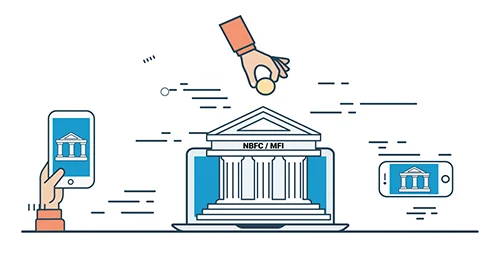
Co-Lending is a lending practice where 2 lenders come together to issue a loan to a priority sector like MSME. First lender can be a bank and the second lender can be an NBFC or HFC (Housing Finance Company).
As per RBI’s Co Lending Model (CLM), banks can contribute 80% of the loan amount while the NBFC can contribute the remaining 20%. NBFC will take care of the sourcing of customers and the collection activity. The risk and reward are shared to the proportion of amount contributed by each lender. Customer will have a single loan agreement where contribution from both lenders will be listed clearly.
For Example, if a MSME customer wishes to borrow 1 lakh, bank can contribute 80,000 and NBFC can contribute 20,000. Bank expects 8% interest and NBFC expects 10%.
In this case, customer will be asked to repay the loan at 8.4% which is a weighted average.
Co-Lending Operating Mode :
CLM Framework address below aspects in Co-Lending
Non-Discretionary loans –Bank can choose to outsource the sourcing activity by NBFC where all loans initiated and appraised by NBFCs will be taken in its books that meet the Co-Lending framework standard.
Discretionary loans – Bank can cherry pick the loans initiated by NBFC. This means the credit appraisal process will be carried out by the bank. NBFC and bank can agree to transfer the whole amount of loan to bank as part of direct assignment (without any minimum holding period)
Both the lenders will have to enter into master agreement which has an agreeable framework on the responsibilities of each lender for sourcing, monitoring, recovery, and securitisation of loans.
- Both the lenders must individually maintain the accounts of the customer on their books.
- All transactions between the lenders should happen through an escrow account. Accounting and regulatory reporting as per the RBI regulated norms
- Asset Classification and NPA provisioning should be handled to the proportion of loan exposure
- Follow business continuity standards and practices like other loans.
- NBFC will be the single point of contact for customers and necessary details of funding (lender and co-lender’s share) and inclusive interest will have to be explicitly made available in loan agreement. This includes sending regular loan statement to the customers.
- NBFC will be responsible for ensuring KYC compliance of customers.
- All customer complaints will have to be addressed within 30 days by NBFC, failing which the customer can approach banking ombudsman for grievance redressal.
Co-Lending is a win-win proposition for banks and NBFCs in addition to enabling affordable credit to MSME customers.
Benefit for Banks :
- Ability to reach the grassroot level customer/customer segment where bank – branch presence is not available.
- Cost of customer acquisition is cheaper as the sourcing process is largely digital.
- Achieve priority sector targets more easily.
Benefit for NBFCs :
- Expansion of customer base resulting in a diversified portfolio.
- Risk and exposure shared only to the proportion of amount lent as part of co-lending deal.
- Reduced capital adequacy needs as part of co-lending instead of allocating full capital on self-funded loans.

How Technology Can Help in Co-Lending
- Technology can play a crucial role in success of co-lending through digital customer onboarding and AI-ML based credit underwriting.
- Aadhaar and PAN based e-KYC authentication coupled with OCR technology has reduced onboarding time drastically these days.
- Lending solutions today can perform internal credit scoring as well as integrate with external bureau to get the credit score.
- AI based models help in analyzing the solvency of customer and predicting loan defaults beforehand. In short, the whole credit appraisal process has become easy with the help of technology.
- EMI Schedule generation needs to be generated separately for lender 1, lender 2 and the borrower. This can be automated by a strong co-lending software solution.
Towards a Bright Future :
Co-Lending has all qualities to bring the informal MSME segment into the financial system through an affordable credit policy. Soon, Co-Lending model will be widely accepted and become mainstream business of NBFC. The spread of co-lending is expected to expand beyond the rails of priority sector lending in India.
The Co-lending market is ripe for harvesting and we could see instances of Co-lending platforms disbursing loans worth Rs 5,000 crore in FY22. Very soon, the Co-Lending market is expected to make loan disbursements worth 10,000 crores.
Choosing the right technology partner plays a significant role in the success of co-lending. Please reach out to our team if you are interested.